

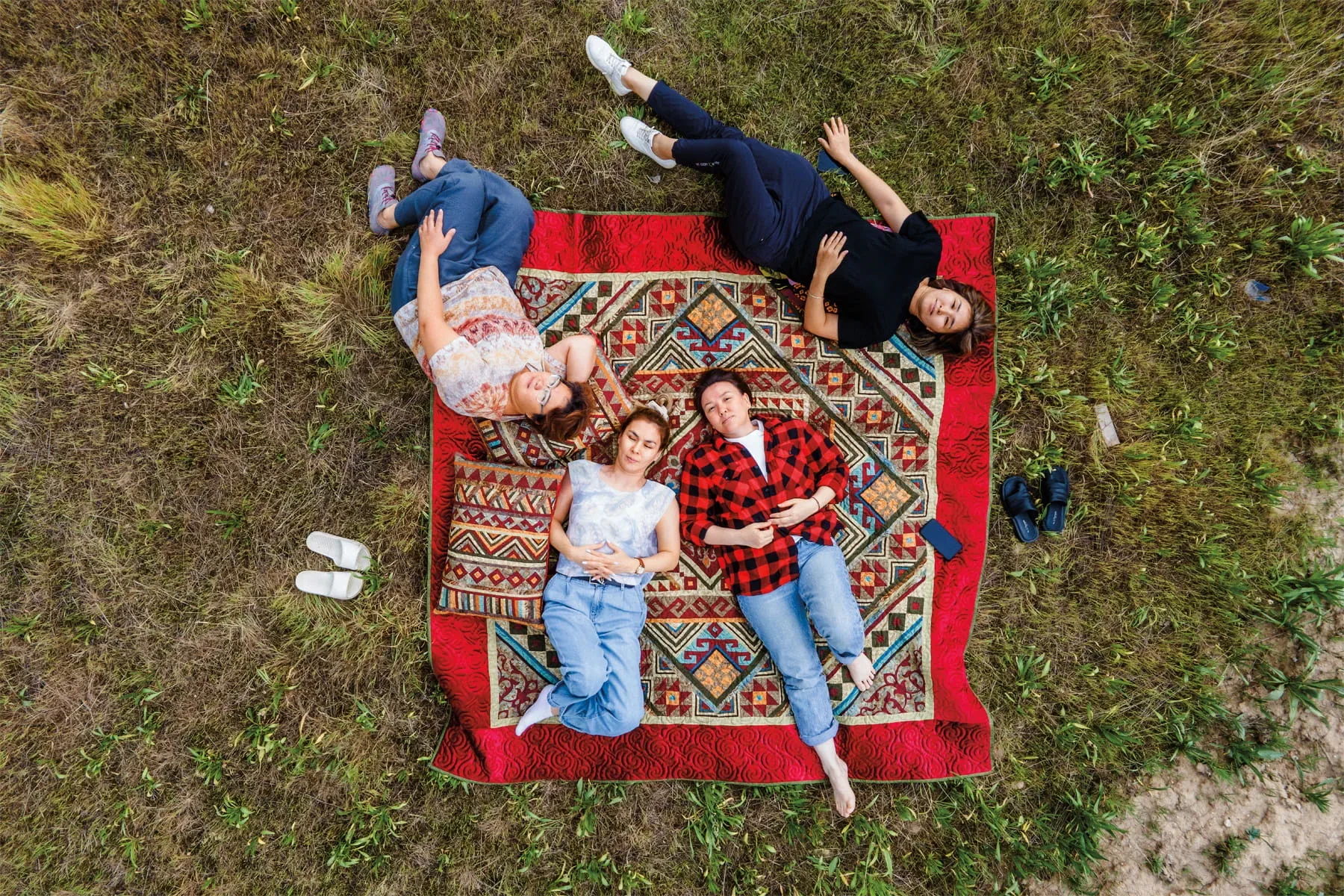
Crafting Identity: The Living Tradition of Kazakh Patchwork Quilts
From a studio overlooking the foothills of the Zailiysky Ala-Tau Range near Almaty, Kazakhstan, three women are quietly working on their next piece of a blanket made in kulak, a traditional Kazakh patchwork technique. They are apprentices of a kulak master and founder of a school dedicated to helping this style of art to rebound. Gilmore Ualikhan pulls out kulak after kulak—pieces of quilt, once present in almost every household in the country—prompting compliments for the women who crafted them from rare fabrics passed along the old caravan trails of the Silk Road. It had both practical use as home décor and as part of a woman’s dowry, and symbolic power as protection.
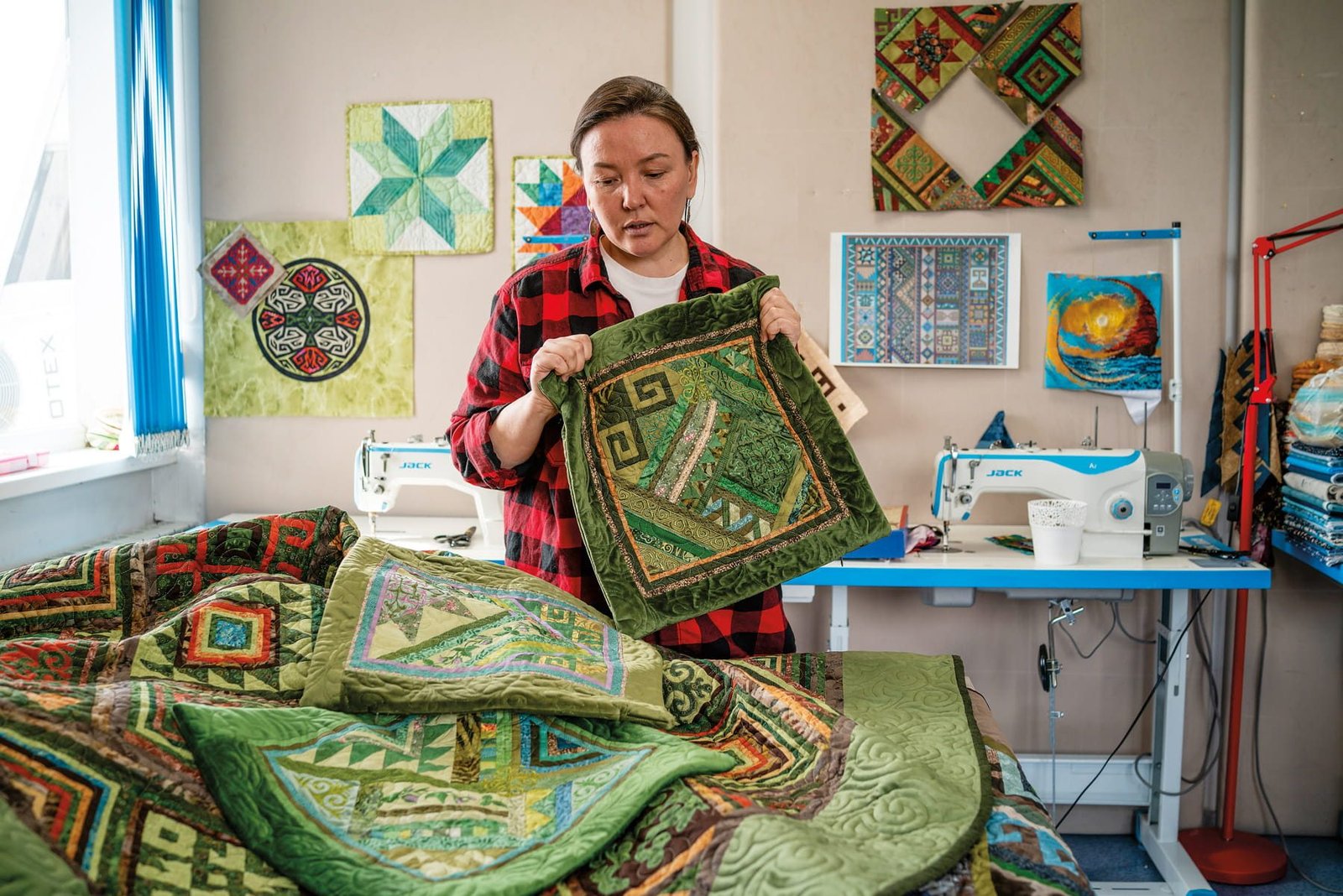
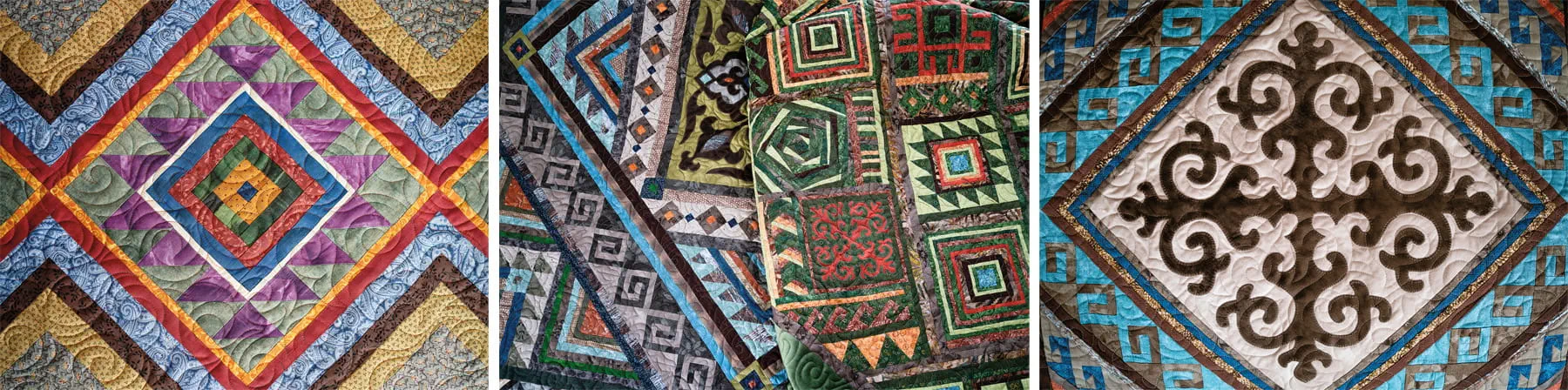
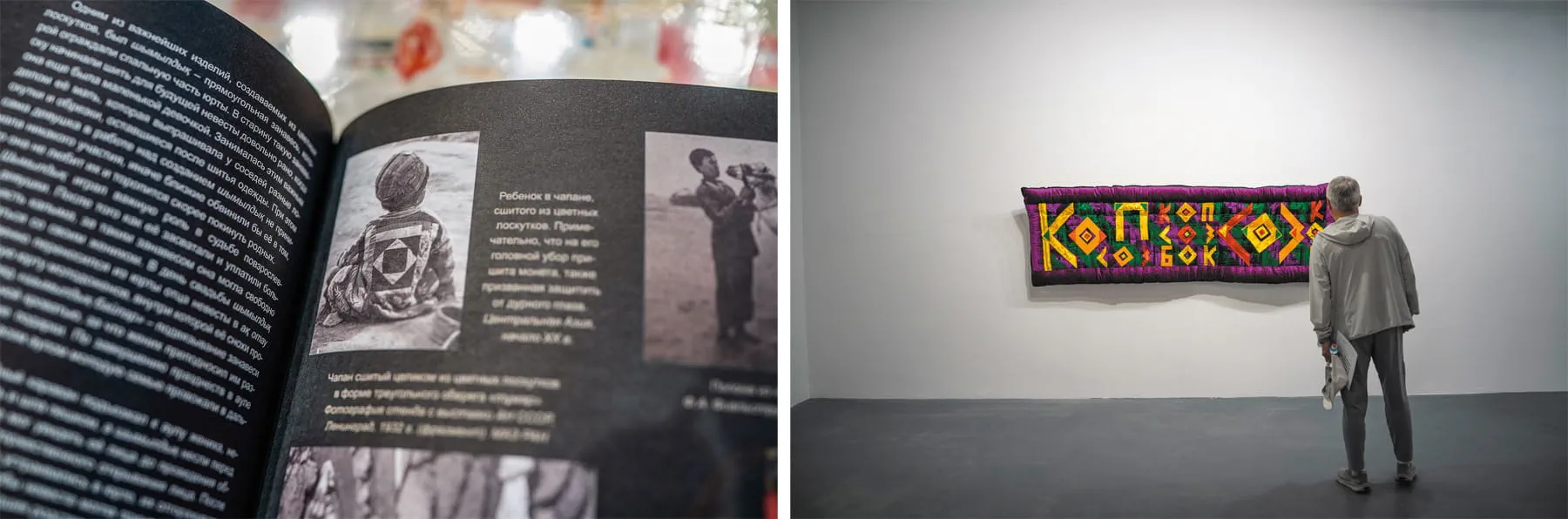
Seeing the toll time and globalization took on the craft, Ualikhan is now slowly reviving the kulak technique, which involves patching together fragments of small textiles in an orderly pattern to form a block. The work fits in with a rising global demand for hand-crafted textiles, inspiring her to reinvent the craft beyond Kazakh patterns. Kurak elements in Kazakh culture Although patchwork is found globally, Kazakhs know it as a common decorative art form. Kura is used in blankets and pillows, carpets and clothing. Ualikhan has spent years researching traditional patterns found in museum collections, old photographs and historical illustrations. Now she applies those patterns in her craft. “This is shi-kurak, the Kazakh block,” says Ualikhan, pointing at a square block that resembles a well. “All over the world, everyone considers it their own, and it’s because it is a fundamental block. Probably because it’s simple and easy for everyone to understand. In Kazakh it comes from the word shy, meaning ‘thin.’ The Russians call it a well.” With symbolic messages woven into the design, every kulak piece holds some of the artisan’s story, thoughts and wishes.
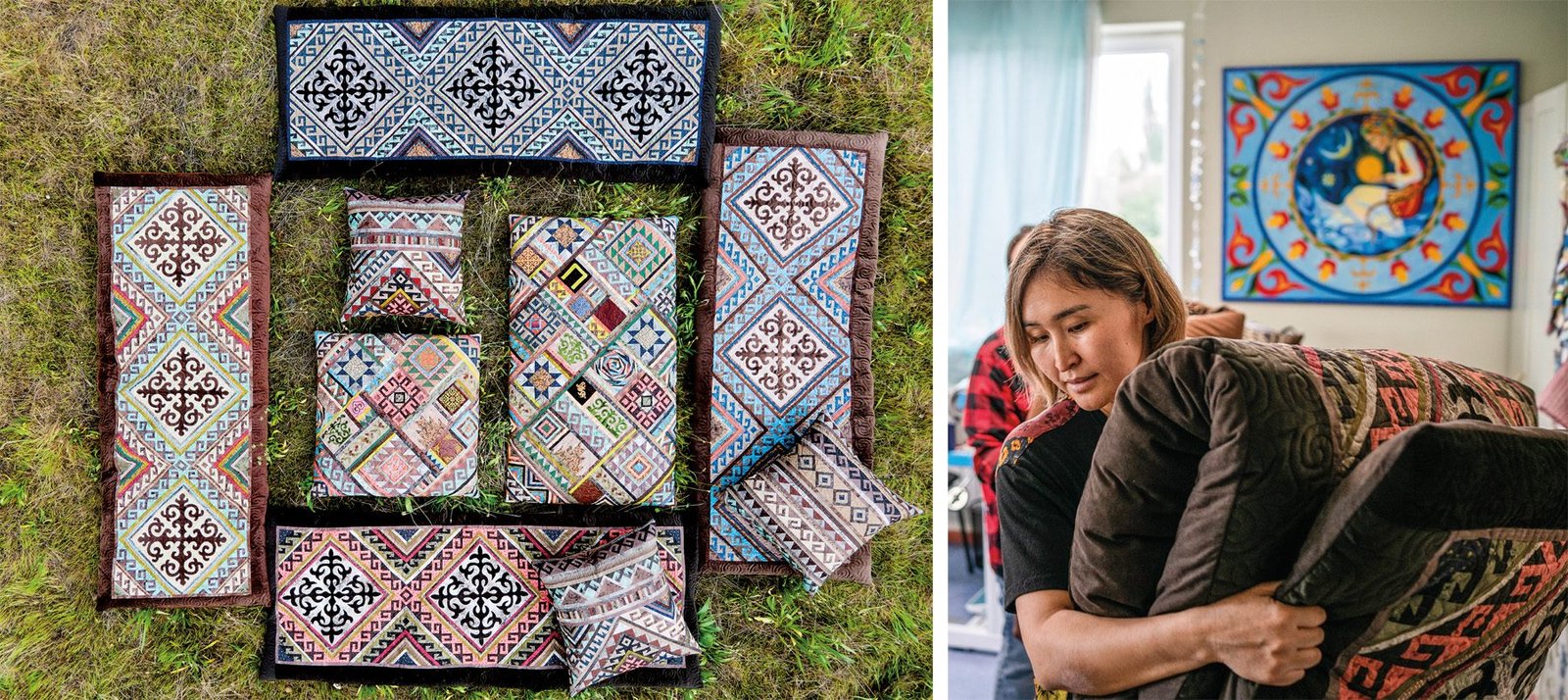
Ualikhan explains the cultural symbolism and beliefs behind each quintessentially Kazakh kulak motif. Over the years, the geometric patterns earned evocative names: ram’s horn, tree of life, axe, pair of earrings, a wave. One of them is a timer—an amulet. “In the past people used to make timers in the shape of triangles and place inside them verses like Hayat Al Kuris [known as the Throne Verse] or other surah’s from the Qur’an. Of course, nowadays, when we sew, we don’t actually stitch those verses into the fabric. But symbolically, we still call it a timer, an amulet,” says Ualikhan.
Kura blankets are a common dowry item, with symbolic messages woven into their design. One such blanket carries blessings for a family: a tree-of-life pattern to denote prosperity, the rhombus for fertility, triangles for spiritual and physical strength, and zoomorphic and nature-inspired patterns like koshkar-muiiz (ram’s horns) to represent masculinity. Every kulak piece holds some of the artisan’s story, thoughts and wishes. “Each of my creations is not just a blanket. It carries the history of my family stitched by the warmth of my hands, the inspiration from great masters and the support of my loved ones,” says Maria Ramazanova, one of Ualikhan’s students.
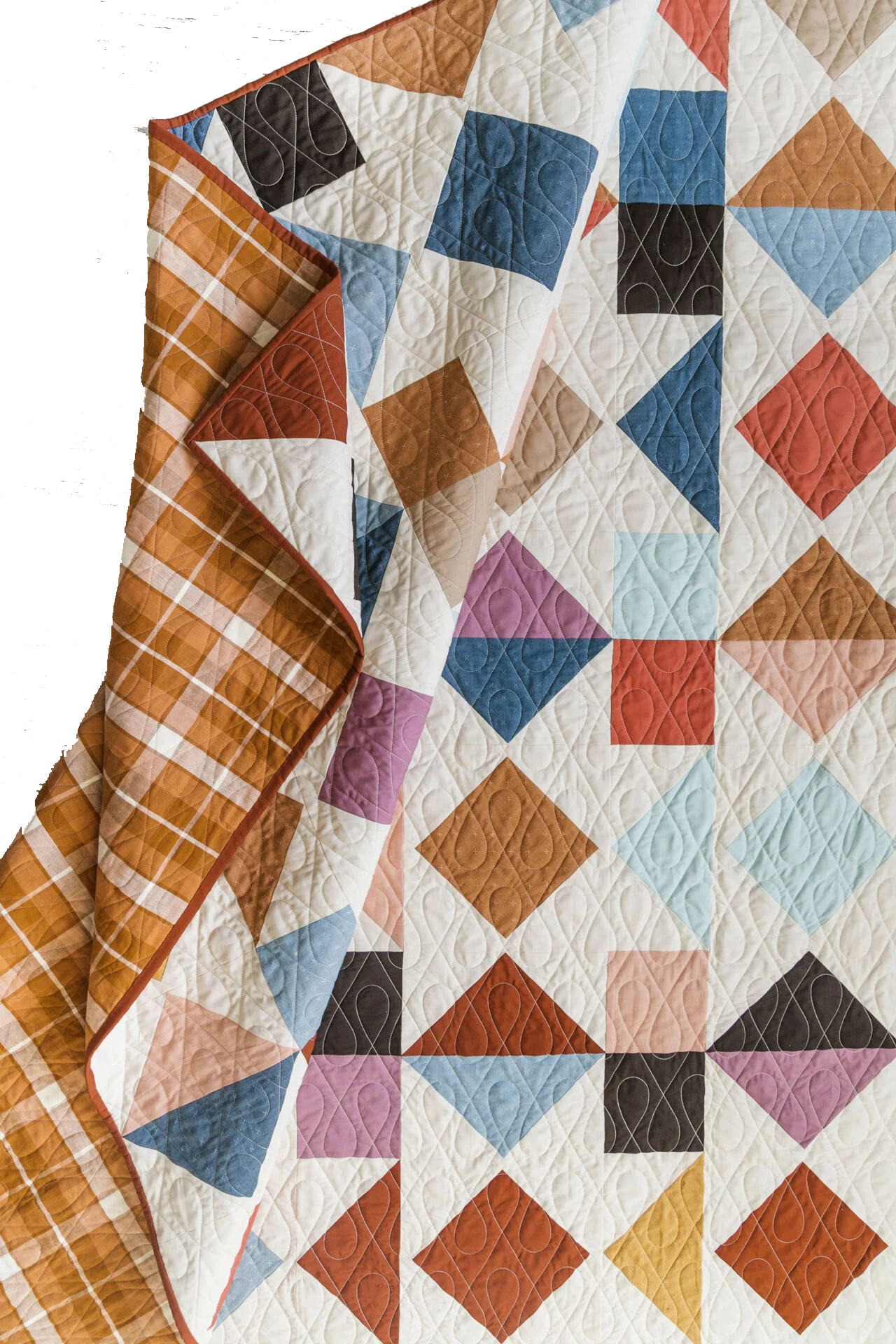
Ualikhan echoes the sentiment: When I sew, I say: ‘I’m stitching my prayer into this piece; may the person or family who receives this quilt be blessed. Along with creating her own patterns, Ualikhan incorporates motifs inspired by cultures around the world. The patchwork technique spread as far as Japan, Europe and the US. “The Japanese are considered one of the strongest kulak masters. Their technique is defined by delicate handcrafted details that reflect a distinctly Japanese touch, and soft, vintage tones. In contrast, Russian fabrics are bright and rustic, filled with polka dots and florals. Kyrgyz designs use bold black, white and red tones, sharp angles and tiny kulak patterns. Classic American style, on the other hand, is marked by large blocks and repetitive patterns, offering a sense of structure and simplicity,” explains Ualikhan. In the US, the International Quilt Museum in Lincoln, Nebraska, boasts a large public quilt collection from over 60 countries to satisfy anyone’s appetite for colour and exuberant detail in patchwork. One can find the black-and-red kulaks from Kyrgyzstan and the soft-toned Japanese pieces Ualikhan mentions, along with quilts from South Asia, China and France, to name a few.

Textile history in Kazakhstan
According to Aznar Altynsaqa, textile artist and researcher, archaeological finds of fabric remnants and needles made of bone suggest that textile traditions have existed across Kazakhstan as far back as the Obtain culture from the fourth millennium BCE. However, surviving kulak pieces mostly date from the 18th, 19th and 20th centuries. Since then, Kazakhs have lost 60% to 70% of their traditional crafts, says Altynsaqa, citing Russian and later Soviet colonization as key causes, alongside the shift from nomadic to stationary life and changing tastes under foreign influence. “Even before the [Russian] revolution, sewing machines, factory-made fabrics, aniline dyes and many other goods began to enter the Kazakh market, with the bulk coming from Russia,” says Altynsaqa.
“All of these items were fashionable and colourful. People began to buy more and produce less themselves.” In the past 10 years, Altynsaqa has observed a revival of traditional art, including kulak, as more artisans emerge “producing modern items using traditional methods, or vice versa, traditional items using modern techniques.” Kazakh textiles date to the fourth millennium BCE, but surviving kulak pieces are mostly from the 18th-20th centuries. Patchwork as therapy In her studio, behind a desk laden with brightly coloured blankets, Ualikhan describes how she tries to restore the value of the patchwork tradition. “My mission, first and foremost, is to research the blocks, then to re-create those blocks in kulak technique and then to pass this knowledge to as many people as possible,” Ualikhan says.

She had a successful career in finance, but after a personal loss, Ualikhan realized stress had taken a toll on her health. Once she gave up her job, the patchwork became a form of meditation. “It turns out that kulak is a therapy. I realized it later. What I was like back then and who I am now are two different people,” she says. A solitary sewer finds herself between art and craft. “When someone sews kulak, they’re alone with themselves. No one is tugging them. They are structuring here, trying to sew even blocks,” says Ualikhan. “And in that process, they learn to navigate and structure situations in life.” Ualikhan went on to open a school that teaches women, including those from underprivileged societies in Kazakhstan, in kulak technique. She teaches the patterns—passed down from mother to daughter—to modern women who are eager to take up the work of their foremothers. Her student Ramazanova recalls the deep inspiration she felt watching every piece of fabric in her hands become a living symbol of tradition. “At that moment, I decided to continue preserving and passing on to future generations a value that is close to the heart of every Kazakh.”

For another of her students, Oral Idelkankyzy, learning kulak has brought a sense of pride. “How happy I was when I managed to complete the simplest blocks! These small victories restored my confidence, my anxieties faded away, and my chaotic thoughts disappeared.” I decided to continue preserving and passing on to future generations a value that is close to the heart of every Kazakh. Kurak’s influence on modern jewelry design Rising desire for handcrafted items has brought a parallel increase in the number of artisans exploring conventional materials and techniques. Mansukh Yesdaulet, a Kazakh artisan specializing in employing kulak technique by hand, is doing her bit via jewellery design. She taught economics at universities, but once she went on maternity leave, Yesdaulet wanted to contribute to the family without a full-time commitment. So, a decade ago she turned her interests into a career that is reshaping what kulak can be.

“As Kazakhs, we all love gold, silver or at least something semiprecious,” Yesdaulet says. “But then I realized my audience is girls who are bold, progressive and a little extravagant—those who are not afraid to look the way they want.” Her amulets, brooches and bracelets embrace vivid colours. Though she mostly sews them in the traditional form of a well, they rather resemble a budding flower or an eye. Each nation has similar ornaments. ... It feels like our essence is the same.
MANSHUK YESDAULET
Kura perfectly expresses the idea of making beautiful products from limited resources, Yesdaulet says. “Back in the days of the Silk Road … fabric was considered a wealth, a treasure—a true luxury,” she says. Even traditional garments like Russian shirts or a Kyrgyz kink (traditional shirt) show that women made use of every part of the fabric. “It was considered a sin to waste fabric,” she adds. Now mass production poses a threat, Yesdaulet says. “Kura is meant to be made by skilled artisans who understand that traditionally it was created from leftover fabric,” says Yesdaulet, “not from brand-new, store-bought red, yellow or blue cloth that’s cut up just for the sake of it.” In 2024 Yesdaulet moved to Palo Alto, California, in the US with her family. Initially she felt lost in a new environment. The soothing nature of hand-sewing kulak lifted her spirits.
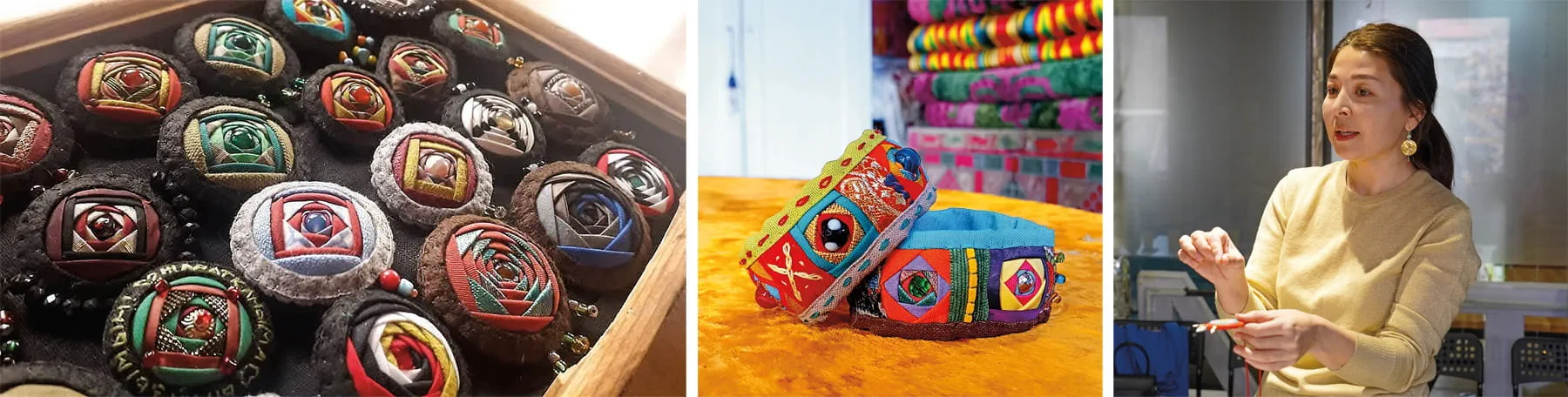
I was doing the one thing I knew how to do, and it helped me get through that time. Now, I want to continue running workshops here or maybe try selling on local marketplaces. I’m not giving up. I want to grow here too, as an artist and a craftswoman,” says Yesdaulet. Kurak across continents Living in the US’ multicultural society, Yesdaulet finds kulak even more relevant, as she puts together pieces from different cultures. Each piece of cloth carries its own story, and when put together, something uniquely beautiful comes forth. “Actually, I see these techniques in every nation, which is interesting. Each nation has similar ornaments, with maybe a bit of variation or a different reading,” Yesdaulet says. “It feels like our essence is the same.” Our children will bring their own worldview and find new ways to weave kulak into their world.
GULMIRA UALIKHAN
Across the globe in Kazakhstan, Ualikhan shares Yesdaulet’s vision of unity rooted in one fundamental block. To her, each kulak reflects the continuity of a collective heritage. “We must teach the basic blocks of kulak to the next generation. Our children will bring their own worldview and find new ways to weave kulak into their world, taking the tradition to new heights,” she says. “But it all begins with the shared foundation we all start from.”
More to Read
All issues
Threads of Heritage — The Enduring Legacy of Kazakhstan’s Syrmak Felt Carpets
For centuries, the vast steppes of Kazakhstan have nurtured a rich nomadic culture shaped by movement, resilience, and a deep connection to nature. Among the many…

Astana to Host Kyrgyz Cinema Days — A Celebration of Culture, Storytelling & Artistic Excellence
In a significant cultural initiative aimed at deepening artistic and humanitarian connections, the city of Astana is set to host the highly anticipated “Days of Kyrgyz…
Kazakhstan Culinary Story — A Journey Through Nomadic Traditions & Rich Flavours
The cuisine of Kazakhstan is a fascinating reflection of the country’s history, geography, climate, and nomadic traditions. Deeply rooted in centuries-old pastoral…