

Royal Heritage, Architecture & Engineering Marvels
Hazret Sultan Mosque
A Monument of Faith & Kazakh Heritage in Astana
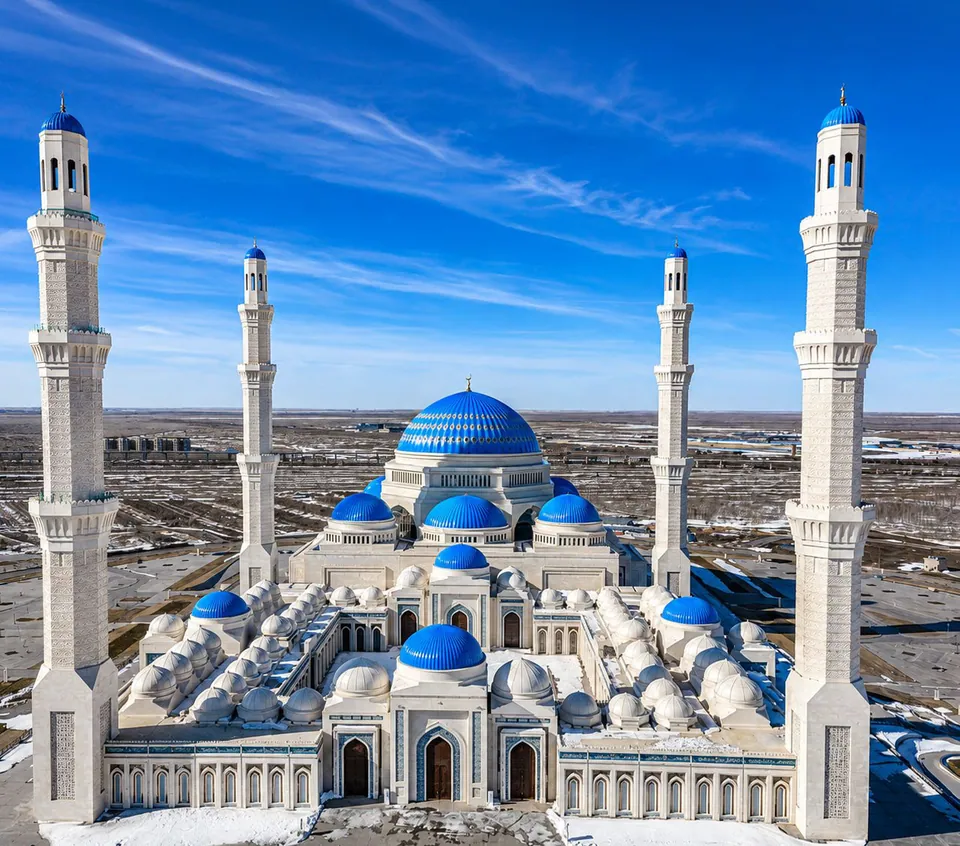
A brilliant white façade on the right bank of the Yesil, four minarets rising above the steppe capital, and prayer halls for ten thousand.
Rising prominently on the right bank of the Yesil River, the Hazret Sultan Mosque is among the most recognisable religious and architectural landmarks of Astana, Kazakhstan. With its brilliant white façade, soaring minarets, monumental dome and intricate ornamental details, the mosque combines the grandeur of classical Islamic architecture with elements drawn from Kazakhstan’s artistic traditions. More than a place of worship, Hazret Sultan has become an important part of Astana’s modern cityscape and cultural identity. Its imposing scale, carefully crafted interiors and connection with the spiritual heritage of Central Asia make it a significant destination for both worshippers and visitors interested in architecture, history and culture. The official Astana tourism authority describes it as one of the city’s most impressive religious monuments and a symbol of spiritual renewal, faith and unity.
Named After Khoja Ahmed Yasawi
The name Hazret Sultan, meaning “Holy Sultan”, refers to Khoja Ahmed Yasawi, the celebrated Turkic Sufi scholar, poet and spiritual teacher whose influence extended throughout Central Asia. Yasawi is particularly revered in Kazakhstan, where his mausoleum in Turkistan remains one of the country’s most important historical and religious monuments. Naming the mosque after Yasawi connects the contemporary capital with a much older spiritual tradition. His teachings and literary legacy occupy an important place in the history of Turkic Islam, making the mosque’s name a reflection of Kazakhstan’s connection to its religious and cultural past.
Classical Islamic Architecture with Kazakh Character
The architectural language of Hazret Sultan draws strongly from classical Islamic forms while incorporating traditional Kazakh decorative motifs. The dominant white colour gives the complex a distinctive appearance, particularly against Astana’s broad skyline and changing seasonal landscape. At the centre is the mosque’s enormous main dome, rising approximately 51 metres and measuring about 28 metres in diameter. Four elegant minarets stand at the corners of the complex, each reaching approximately 77 metres. Eight smaller domes surround the central dome, creating a layered silhouette that gives the building its palace-like appearance. The exterior decoration incorporates traditional Kazakh patterns alongside Islamic ornamentation. These details create a visual connection between the architectural traditions of the wider Muslim world and the distinctive artistic heritage of Kazakhstan.
“The mosque can accommodate up to ten thousand worshippers — a place of daily prayer, of learning, and of gathering.”
A Monumental Interior
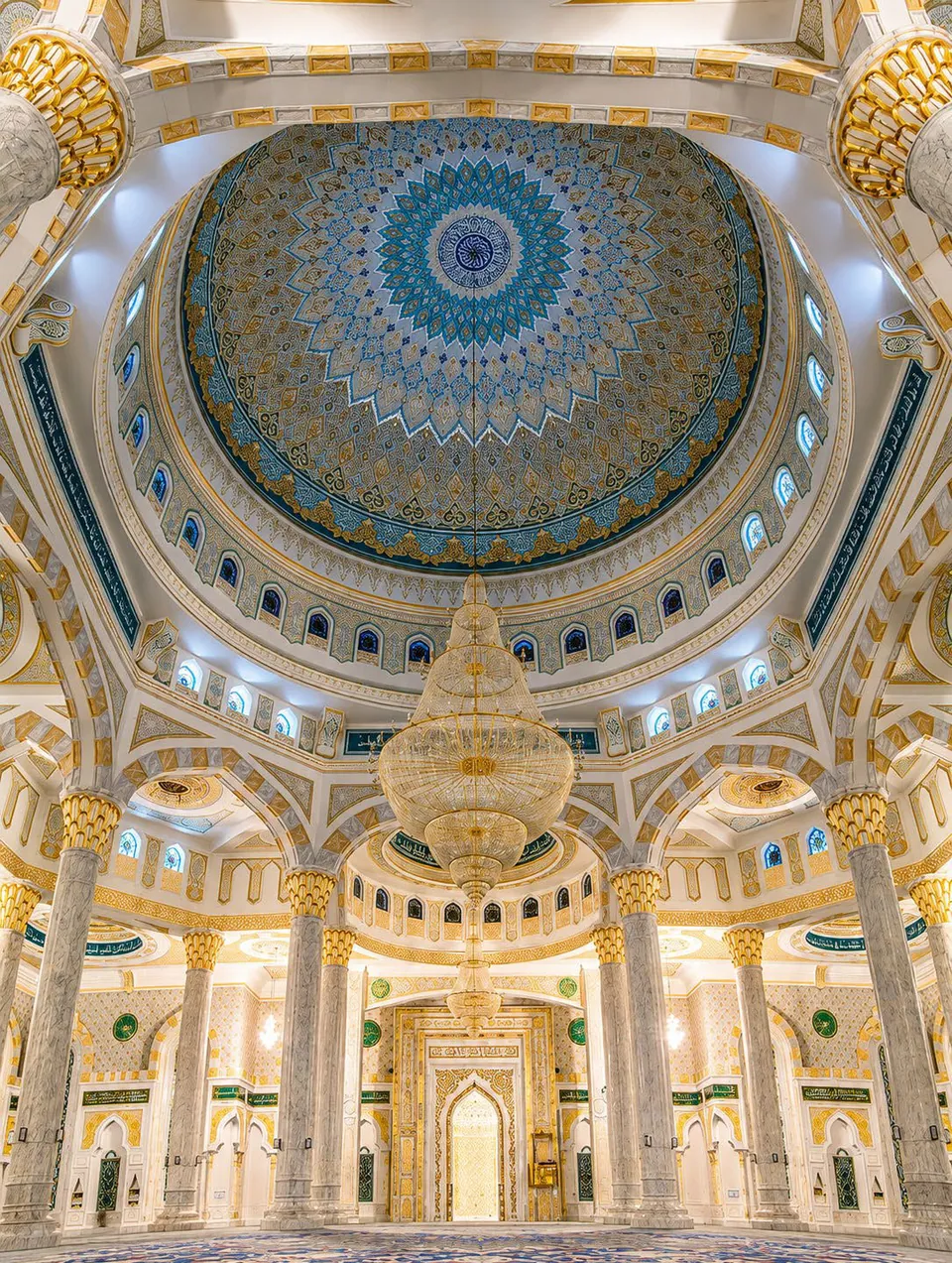
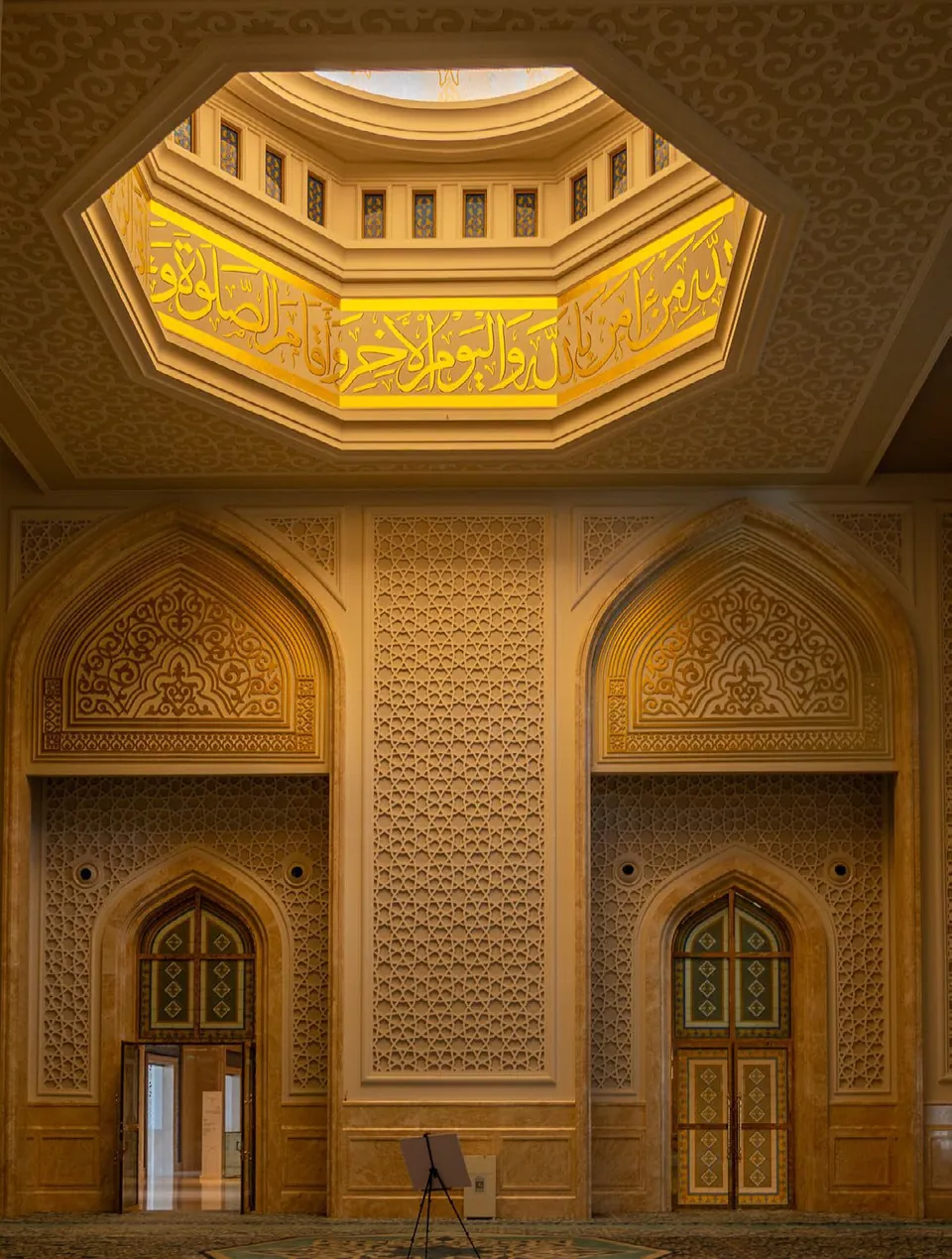
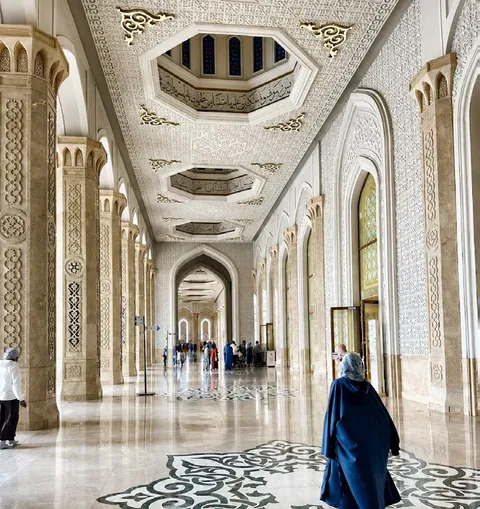
The sense of scale continues inside the mosque. Spacious prayer halls are supported by substantial white columns, while decorative surfaces, ornamental details and large chandeliers contribute to the building’s grand yet harmonious atmosphere. The mosque was designed as a functioning religious and educational complex rather than simply as a monumental structure. Its facilities include prayer spaces, ablution areas, classrooms, Quran-reading rooms, a library and spaces associated with religious and community activities. Historical descriptions of the complex also record a wedding hall and separate prayer facilities for men and women. The central hall is particularly striking, with its large columns and impressive chandelier reinforcing the monumental character of the interior. At the same time, the use of traditional ornamentation gives the vast spaces a distinctly regional identity.
A Centre for Worship & Community Life
Hazret Sultan functions as a major congregational mosque and can accommodate up to around 10,000 worshippers, particularly during major religious gatherings. Its design reflects the mosque’s role not only as a place for daily prayer but also as a centre for religious learning and community activities. Educational spaces allow Quran reading and religious instruction, while facilities for ablution and other community functions support the needs of worshippers. This combination of monumental architecture and practical facilities makes Hazret Sultan an important institution within the religious life of the capital.
A Distinctive Presence on the Astana Skyline
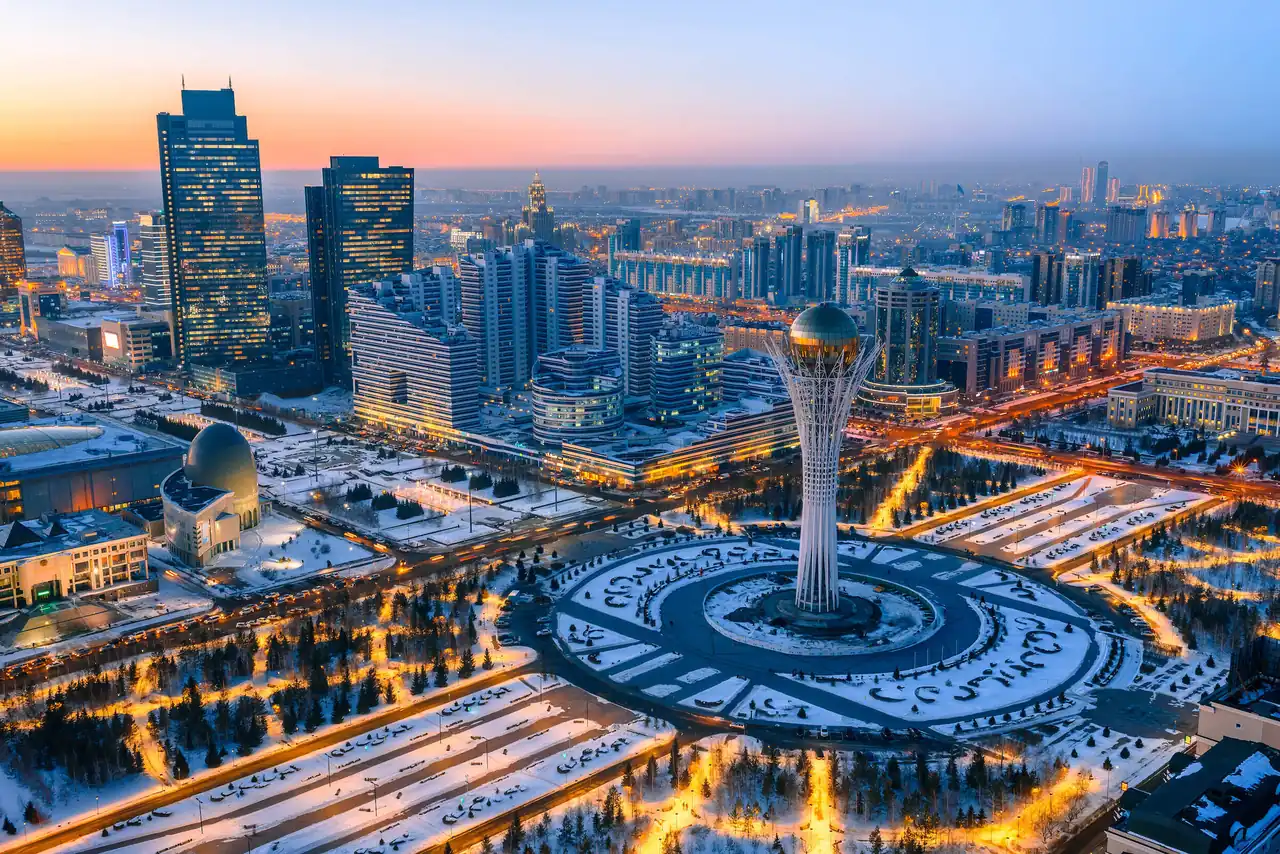
The mosque occupies a prominent location near several of Astana’s major landmarks, including Independence Square, the Palace of Peace and Reconciliation and the Kazakh Eli monument. This setting places Hazret Sultan within one of the city’s most significant cultural and civic districts. The surrounding urban landscape also highlights an important characteristic of Astana: the juxtaposition of traditional cultural references with bold contemporary architecture. Hazret Sultan contributes to this visual dialogue through a design that is rooted in Islamic architectural traditions while appearing unmistakably monumental within Kazakhstan’s modern capital. Its white exterior becomes especially distinctive against the city’s winter landscape, while evening illumination brings out the vertical emphasis of its minarets and the geometric character of its domes.
The Silver Quran
Among the objects associated with the mosque is a remarkable Silver Quran, presented as a complete copy of an ancient Quran manuscript tradition. The work consists of 162 silver plates and was created as an artistic and religious object rather than being the original historic manuscript itself. The Ministry of Culture of Tatarstan records that a complete set of the Silver Quran was presented to Hazret Sultan as a gift. The object adds another layer to the mosque’s cultural significance, bringing together religious devotion, craftsmanship and the broader artistic traditions associated with Islamic manuscript culture. Claims sometimes made about an original ancient Quran manuscript being housed at the mosque should be treated cautiously; reliable official sources clearly document the Silver Quran, while the more dramatic descriptions of an original manuscript associated with Amir Timur are not consistently substantiated.
A Symbol of Contemporary Kazakhstan
Hazret Sultan represents more than architectural ambition. Its creation reflects Kazakhstan’s effort to express its religious and cultural heritage within the rapidly developing landscape of its modern capital. The mosque’s monumental form, traditional Kazakh ornamentation and association with Khoja Ahmed Yasawi create a bridge between historical identity and contemporary national life. Official descriptions have characterised the mosque as a symbol of spiritual revival, faith and unity, highlighting its broader cultural role within Astana. Its importance is also enhanced by its location among some of the capital’s most recognisable national monuments. Together, these landmarks create a cultural district where Kazakhstan’s history, spirituality and modern state identity are represented side by side.
Visiting Hazret Sultan Mosque
For travellers exploring Astana, Hazret Sultan Mosque offers an opportunity to experience both religious architecture and Kazakhstan’s cultural heritage. Visitors can appreciate the building from the surrounding public spaces before entering the mosque, where appropriate modest clothing and respectful behaviour are expected. The mosque can also be incorporated into a wider sightseeing route covering the nearby Independence Square, Kazakh Eli monument and Palace of Peace and Reconciliation. Its striking architecture makes it particularly compelling for visitors interested in photography, Islamic design and the cultural character of Kazakhstan’s capital.
An Enduring Architectural Landmark
Hazret Sultan Mosque stands as one of Astana’s defining religious landmarks. Its immense central dome, four soaring minarets, white architectural palette and Kazakh-inspired ornamentation give it a powerful visual identity, while its prayer halls, educational facilities and community spaces preserve its essential role as a working mosque. Ultimately, the significance of Hazret Sultan lies in the way it brings together faith, architecture, history and national heritage. Named for one of Central Asia’s most influential spiritual figures and positioned among the defining landmarks of modern Astana, the mosque offers a striking expression of Kazakhstan’s cultural identity—where centuries- old traditions continue to find a place within a contemporary capital.
Continue exploring